
One thing leads
One thing leads to another.
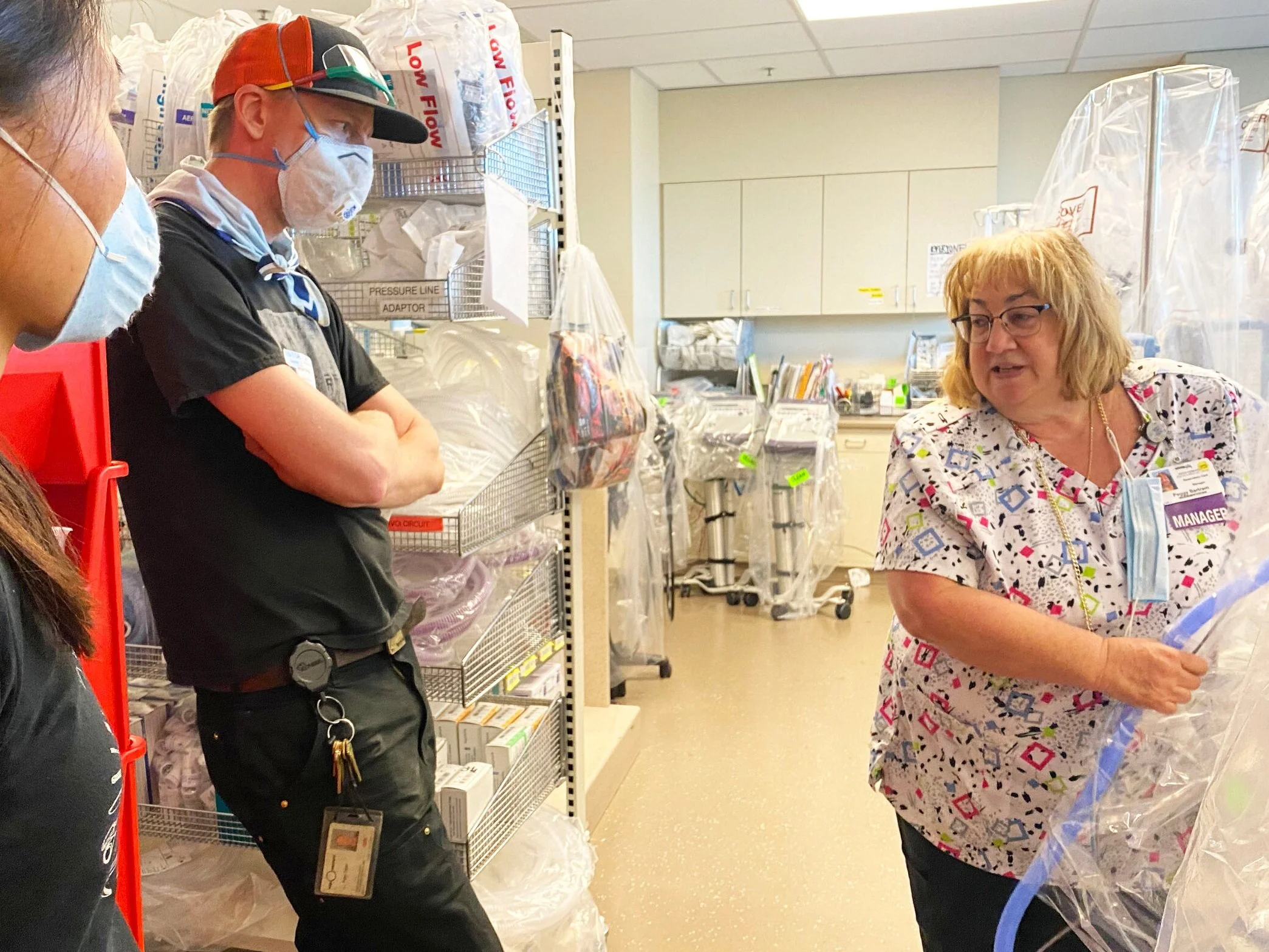
Yesterday, we (with Peter Taylor and Gaia Liu) were called because a hospital in Oakland had 18 broken CAPR and PAPR units. These devices deliver filtered air to health workers, particularly working in COVID units. These four had broken tabs? We had some 3D printed replacements. Those were quick. Ooo, broken lens? That one's out, but we can use the filter to replace another one. Twelve of them needed plastic shells all together. Can we make that?
As we were working, one of the heads of respiratory pulled us into a side supply room. She had purchased top-of-the-line ventilators from Germany a while ago as part of an agreement with the CDC to be a ward in case of ebola. She was missing a small part on many of them. It's a small plastic manifold that separates the inhalation and exhalation lines, critical for each machine. Every patient needs a new one. Peter took one of the sample parts home. He thinks he can reverse engineer it and get a workable print within a day. We'll most likely be able to share files within the week. Gaia walked out with 12 PAPRs. She'll fix everything she can within the next couple of days.
The needs are shifting, and we are constantly learning of new ones. Just this week, we've started work on impermeable gowns, independent PAPR units, and test kits. We learn of new things, try to figure out a way to solve it, fabricate some, share designs, and try to entice larger industries to take it and make it on their own. Some are quick to pass through (face shields) and some are much, much longer (PAPR lens cuffs). Regardless, we're learning a ton every time we get close to a health worker.
It keeps shifting.
But so must we.
